Recent art that you liked

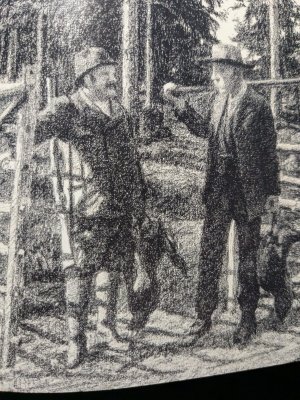
On the same line, I was greatly surprised by Fridtjof Nansen's artwork, explorer of the North Pole, scientist, diplomat, winner of the Peace Nobel Price, and artist.
 

Attachments

  • c9a355ca-5fd2-44aa-827c-5dafeb133458.jpeg
    c9a355ca-5fd2-44aa-827c-5dafeb133458.jpeg
    419.6 KB · Views: 32
It seems that painting and calligraphy were part of the average education for the upper classes or the educated in the past. I’ve seen painting by authors such as Edgar Allen Poe and Victoria Hugo and they could easily be accepted into most art schools from the last 100 years.
 
IMG_6868.jpeg


IMG_6872.jpeg


I just came upon these two paintings by Robert Winthrop Chanler (American, 1872-1930). He was an American artist whose works merged elements of the decorative with the bizarre. He was a member of the Astor and Stuyvesant families… both wealthy and politically connected families in the US. His personal life included a whirlwind romance with the beautiful and talented soprano, Lina Cavalieri…

IMG_7864.webp


The married in June, 1910 but were separated by the end of their Honeymoon. His murals often involved the use of plaster, sculpted gesso, and gilding. Among his murals is a decorative ceiling at the Gertrude Vanderbilt Whitney Studio.
 
Ran into these, by one Martin Watsfeldt, on Instagram:

Martin Watsfeldt - Amusement Park, oil on canvas 95x90 cm.jpg

Amusement Park. Oil on canvas, 95 x 90 cm.

Martin Watsfeldt - Burial Oil on canvas 120x115.jpg

Burial. Oil on canvas, 120 x 115 cm.

Martin Watsfeldt - The Call, Oil on canvas 120x115 cm.jpg

The Call. Oil on canvas, 120 x 115 cm.

Martin Watsfeldt - White Dove, oil on canvas 75x70 cm.jpg

White Dove. Oil on canvas, 75 x 70 cm.
 
Cascade by Eric Wert.
Not sure if the pictures will size-up well enough to make everything out. But the piece is incredibly detailed.
1000007756.jpg

Quite a large painting too.
1000007757.jpg


Really beautiful oil painting, with a lot of detail and lovely colors. :)
 
Looks pretty real to me. The article I saw it in was an interview about his work, and included several progress photos from his initial still-life setup, beginning sketch, grisaille, glazing and detail layers. Including several shots of him actively in the studio.

He has several other similarly impressive oil paintings you can easily find, and is represented by Gallery Henoch in New York.
 
I was being facisius. I have no reason to doubt it.

But every picture or video I see on youtube - the first comments are accusing works of being "Ai" and it's becoming increasingly hard/impossible to tell. People are creating fake preliminary work to "prove" their work is original and not Ai.

THere is this forum I sometimes visit, where people create, share, sell, and commission digital fantasy art. Many claim Ai work is original just to gain likes, prestige-followers. The moderator is a forensic expert in detecting Ai fraud. All the work on the site is digital fantasy art, created by digital artists with no Ai allowed. It is amazing the tell-tale minutiae that are uncovered to expose Ai work. No doubt Ai will soon learn to cover those tracks as well

 
Not sure I like this one, but its backstory is of interest, so I'll pop it in here:

55194568806_8099e3faac_b.jpg

Wolfe von Lenkiewicz - A Promise [2025] Oil on canvas, 50 x 50 cm.

I found the image on Gandalf's Gallery, and what is of interest to me here is the description:

The artwork is created by generating initial concepts using AI algorithms, which are then meticulously painted onto canvas using traditional oil painting techniques. Lenkiewicz reconfigures iconic imagery from art history and visual culture to create ambiguous, psychological scenes that explore themes of identity and intimacy

I was wondering just yesterday when we would see more and more of this: using AI to create reference images to paint from. Does it open an ethical can of worms? Perhaps a godsend for those of us who, like me, don't have much of a visual imagination? How would one even be able to tell whether the artist copied an AI-generated image as opposed to creating his own? And as AI uses ever more AI-generated imagery to train on, where will this (assuming it becomes very common) lead AI-generated imagery? Already it seems caught in a loop which Nassim Taleb referred to as "a self-licking lollipop", which is perhaps partly why AI-generated art is ever more recognizable as such - it seems to have a particular "look" about it.

We sure are tumlbing down an ever deepening rabbit hole... :-)
 
Back
Top